The Mission
Wireless development now spans sub-6 GHz FR1, millimeter-wave FR2, and the early reach toward 6G frequencies. Across all of it, engineers test amplifiers, front-end modules, and receivers against realistic modulated signals. The source has to produce both clean continuous-wave references and standards-based vector waveforms, then move quickly between frequencies as automated test sequences run.
The Challenge
Modern wireless modulation is unforgiving of a noisy or distorted source. High-order QAM and wide channel bandwidths push error-vector magnitude budgets tight, so the generator's own phase noise and modulation quality directly limit how good a result you can measure. The work also reaches into millimeter-wave, which rules out any source that stops in the low gigahertz. Vector capability and wide frequency coverage both have to be on the table.
Recommended Berkeley Nucleonics Solutions
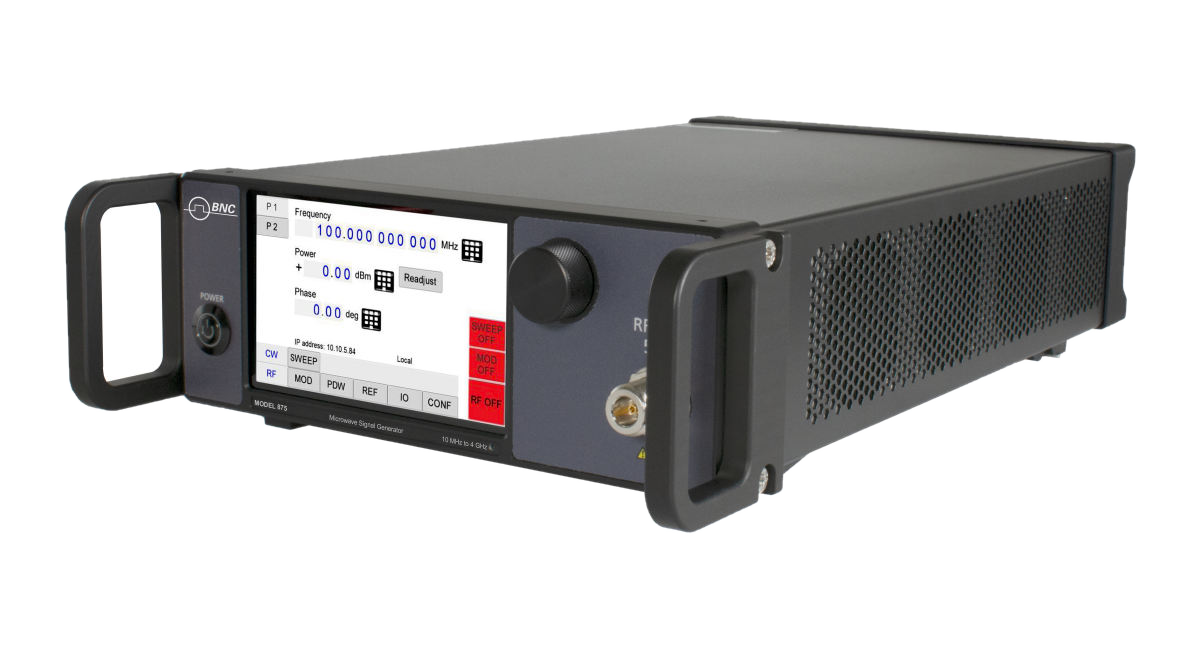
The Model 875 is the vector signal generator for this domain, with internal I/Q modulation, standards-based digital modulation (including 3GPP, GSM/EDGE, and CDMA2000), and coverage to 40 GHz that reaches FR2 millimeter-wave bands. Its 1, 2, 3, or 4 phase-coherent channels support MIMO and multi-port front-end test.
For clean wideband CW references and blocker generation, the Model 855B delivers up to eight phase-coherent channels with the family's highest output power (+25 dBm). The Model 845 covers 100 kHz to 26.5 GHz with full analog modulation for component and IF work, and the Model 865B provides a compact, low-phase-noise bench source to 40 GHz for receiver and converter characterization.
Why It Works
The 875 generates the standards-based vector waveforms wireless test actually needs, so the bench can drive a real modulated signal rather than a bare tone. Low phase noise across the family keeps the source out of the EVM budget, which is what lets you certify high-order modulation with confidence. Coverage to 40 GHz reaches FR2, and the shared coherent multi-channel architecture supports MIMO and multi-antenna scenarios from a single instrument.
Getting Started
Berkeley Nucleonics applications engineers help match the right source, channel count, and options to your test plan. Tell us your frequency span, switching budget, and channel needs, and we will recommend a configuration and arrange a demo.
Contact info@berkeleynucleonics.com or call 800-234-7858. Browse the full family on the RF & Microwave Signal Generators documentation page.