The Mission
Quantum processors are built on microwave control. Superconducting qubits are driven and read out with carefully timed microwave tones, and trapped-ion systems lean on stable RF and microwave fields. Gate fidelity, coherence times, and crosstalk rejection all trace back, in part, to the spectral purity and phase stability of the sources behind the experiment. As qubit counts grow, the control problem becomes a multi-channel problem.
The Challenge
Close-in phase noise translates directly into dephasing, so a source with poor 1 kHz performance erodes the coherence the whole system is trying to protect. Multi-qubit control then demands several outputs that stay phase-coherent with one another, with independent frequency, power, and phase per channel, so each qubit can be addressed without disturbing its neighbors. Channel-to-channel isolation matters as much as the noise floor.
Recommended Berkeley Nucleonics Solutions
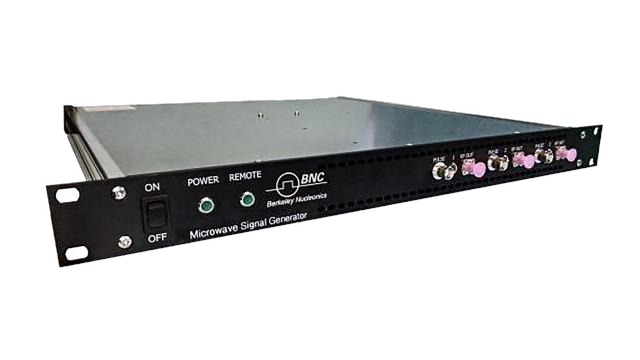
The Model 865B-M sets the close-in benchmark for the family at -130 dBc/Hz at 1 kHz offset (1 GHz carrier), in a compact 2.1 lb module that runs on a single DC supply. For multi-qubit work, the Model 865B-M-40-X brings that same low-noise core to as many as four fully independent outputs, each with its own frequency, power, phase, and modulation, plus a high-isolation (-HI) option for tightly packed channels.
The Model 845-M is a small single-supply microwave synthesizer module (10 MHz to 20 GHz) with -118 dBc/Hz at 1 kHz, available as one or two outputs, suited to embedding inside a control rack. Where a full bench instrument with many synchronized channels is preferred, the Model 855B provides up to eight phase-coherent outputs and a dedicated reference I/O for locking multiple units together.
Why It Works
The synthesizer modules in this family were designed around close-in phase noise, which is exactly the metric that governs qubit dephasing. Independent-per-channel control on the 865B-M-40-X lets one instrument address several qubits at different frequencies while staying phase-coherent, and the high-isolation option keeps neighboring channels from leaking into one another. Compact single-supply modules slot into existing control electronics rather than forcing a rack of separate generators.
Getting Started
Berkeley Nucleonics applications engineers help match the right source, channel count, and options to your test plan. Tell us your frequency span, switching budget, and channel needs, and we will recommend a configuration and arrange a demo.
Contact info@berkeleynucleonics.com or call 800-234-7858. Browse the full family on the RF & Microwave Signal Generators documentation page.