1Overview
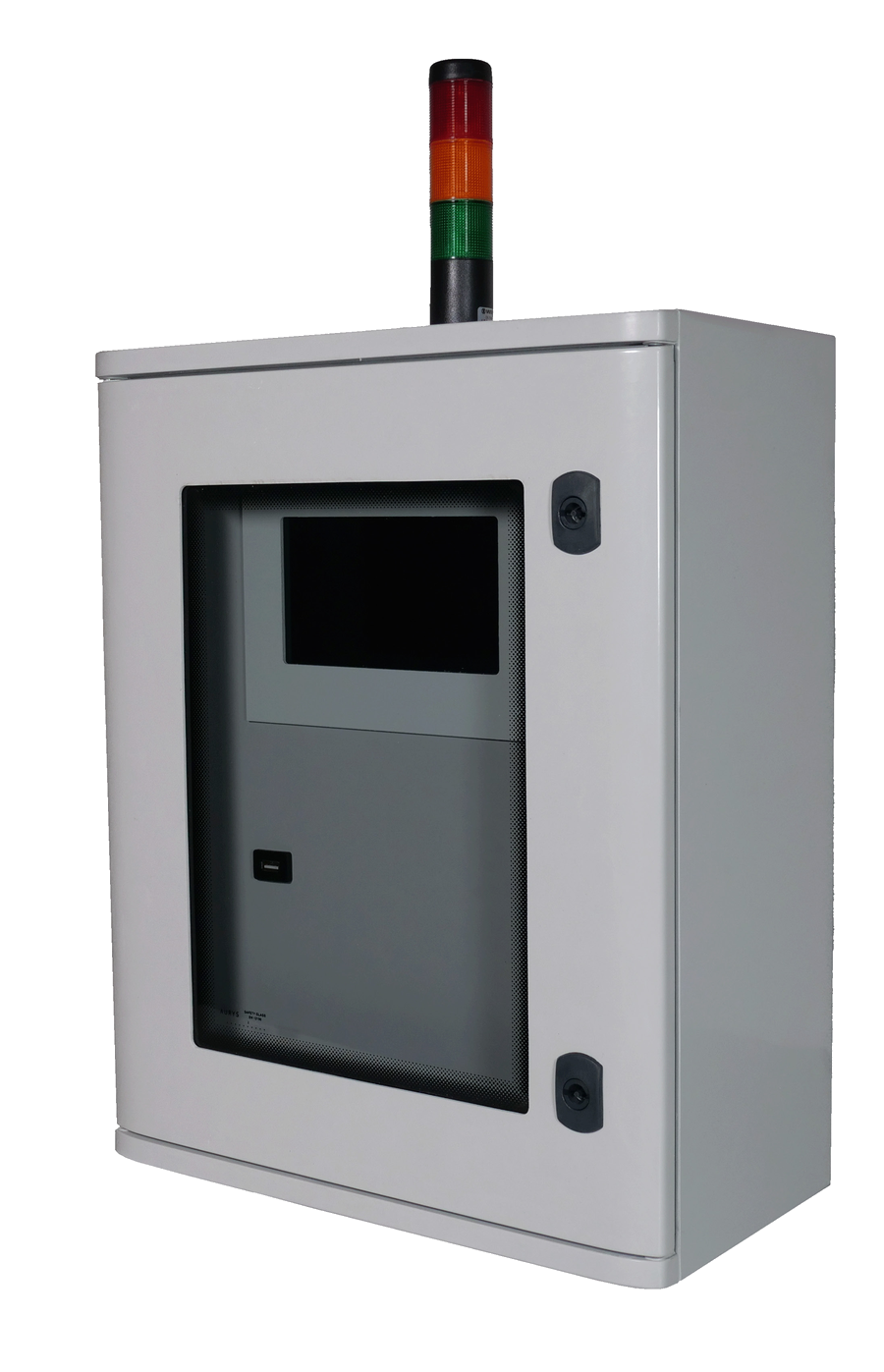
The Model 960 Radiation Monitoring System is a fixed, installed monitor for gamma and neutron, X and gamma radiation, with real-time data acquisition and continuous background measuring. It uses a NaI or sturdy plastic detector, settable alarm thresholds, and high sensitivity up to 150 kcps/µSv/h.
The system ships in three configurations matched to the site: a Pedestrian (960-P) gamma monitor for homeland security and critical sites, a Hospital Waste Check (960-H) monitor for incinerators, steel plants, and waste management centers, and a Conveyor Belt or Area Monitor for the recycling industry. Each can be controlled from a nearby or office PC, with local and/or remote alarms.
2Features
- Gamma & neutron radiation monitoring
- X & gamma radiation monitoring
- Real-time data acquisition
- Continuous background measuring
- NaI or sturdy plastic detector
- Settable alarm thresholds
- High sensitivity: up to 150 kcps/µSv/h
3Key Applications
- Discrete perimeter monitoring
- Unmanned remote monitoring
- Cargo container security
- Conveyor or robotic system integration
- Surveillance of critical infrastructure
- Other moving source locations (Medicine Departments, Personnel Doorways, Conveyor Belts)
4Pedestrian (Model 960-P)
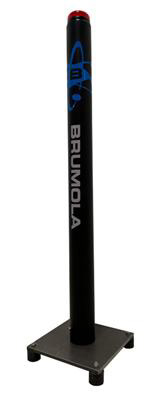
The Model 960-P is a gamma radiation monitor, specifically developed for homeland security and monitoring of critical sites such as official buildings, sport events, airports etc. Highly reliable, ensure a precise response in a large range of energies. It is controlled by a PC placed nearby or in an office, while the alarm could be local and/or remote.
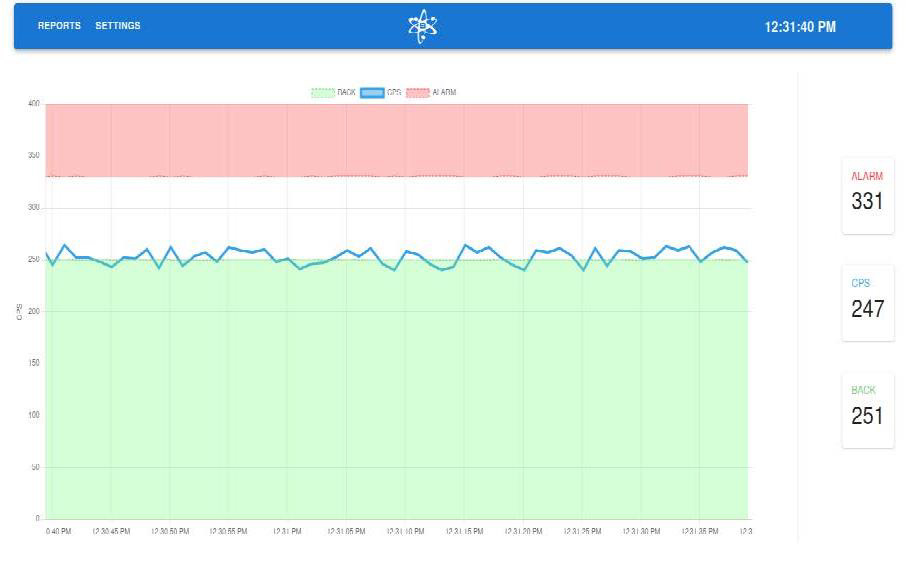
Able to measure gamma count-rate, it is fitted for screening pedestrians on site. When in stand-by, Model 960-P continuously measures background radiation. Every second it recalculates a background value as the average of the last 300 seconds (5 minutes). The system offers the possibility to select alarm thresholds for gamma and provides a sound and light alarm when the thresholds are exceeded.
It is possible to print alarm reports on a local or remote printer (via network). The system can also be fully managed remotely from any PC on the local network after entering the access password.
Technical features
| Parameter | Specification |
|---|---|
| Configuration | Stand-alone unit, self-supporting |
| Detector | Gamma detector with PMT; NaI 2x2 in or 3x3 in |
| Measuring range | 100 nSv/h - 40 mSv/h |
| Energy range | 60 keV - 6 MeV |
| Operative temperature | 5 - 45° C |
| IP 65 protection | Indoor and/or outdoor applications |
| Communication interface | Ethernet and Wi-Fi, access from PC or tablet |
| Settable alarm thresholds | Optical and acoustic alarm |
| Supply | 110 / 220 VAC |
| Weight | 8.16 lbs. |
| Height | 47.2 in |
| Diameter | 11.8 in |
Optional
- Local display unit
- Neutron detector: 100 nSv/h - 150 mSv/h - 1 MeV - 20 MeV
Assuring safety during operations in critical sites such as borders, airports, court houses, sport events, seaports, etc. is often the number one concern. The Model 960-P is the suitable solution when these issues are considered.
5Hospital Waste Check (Model 960-H)
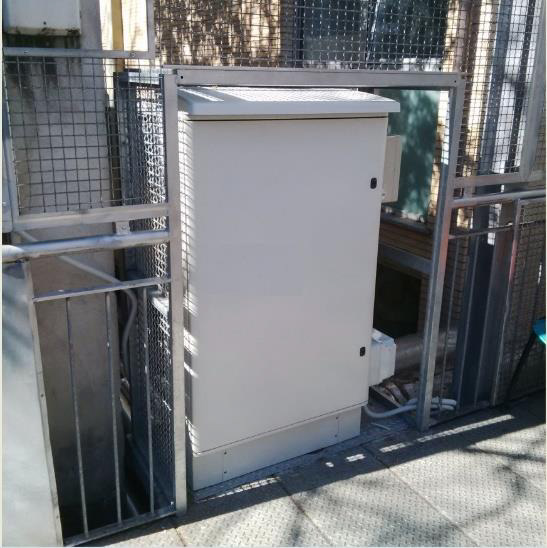
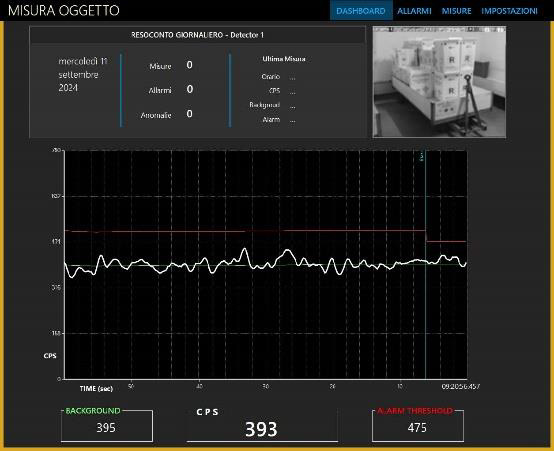
When in stand-by, the Model 960-H continuously measures background. Every second recalculates background as the average of the last 300 seconds (5 minutes). Suitable selective presence sensors stop background update and start the measurement when an object passes (person, trolley, vehicle, etc.). This prevents unwanted alarms caused by the passage of unrelated people or objects.
The system offers the possibility to select an alarm threshold and provides a sound and light alarm when this threshold is exceeded. Each detector is shielded by 1 cm of Pb with the dual purpose of shielding background and increasing measurement efficiency by providing some backscattering. It is possible to print alarm reports on a local or remote printer (via network). The system can also be fully managed remotely from any PC on the local network after entering the access password.
Features
- Plastic scintillation detector, 5, 12 or 25 L, 1 cm Pb shield on the back side, IP 65 container with ventilation holes
- Sensitivity: 20, 80 or 150 kcps/µSv/h (137Cs)
- Flexible configuration (detectors number and size)
- Ultra-fast acquisition unit, connected to a panel PC installed on the wall, in a container with a transparent front window and temperature compensation
- Settable alarm thresholds
- Continuous background updating and automatic measuring activation by sensors
- Digital connection with electronic noise reduction
- Self-diagnosis with dedicated alarm
- Control PC with Brumola software in Windows™ environment
- Possibility of remote access (protected by PW) via ethernet network
- Optional: video camera, local alarm, speed measurement, custom carpentry
- Printing of measurement and alarm reports in cps on a local or network printer
Safety & Savings
Many incinerators, steel plant or waste management centers are now equipped with radiometric control systems at the entrance. This sometimes causes problems due to the accidental arrival of hospital waste contaminated with medical radioisotopes which, at times, do not come from the nuclear medicine ward but from hospital wards (diapers, gauze, etc.) together with normal waste. Due to the short half-life of medical radioisotopes, the real radiological risk is often very low, but the economic and legal impact is not negligible. Regarding metal scrap yards it's not so difficult to find out orphan sources of contaminated metals, a monitor like this could be placed anywhere in your plant.
6Conveyor Belt or Area Monitor
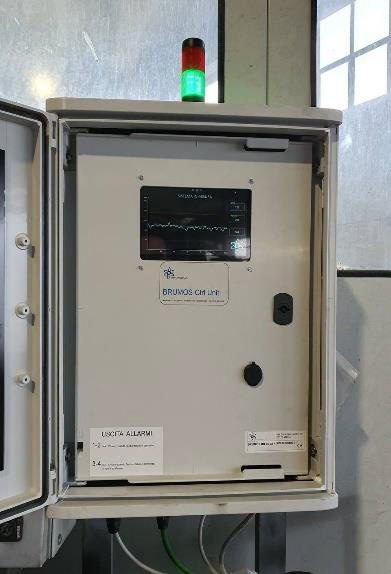
This configuration is designed for the recycling industry. Being positioned very close to the conveyor belt, it features very high sensitivity for hidden sources, with virtually 100% detection probability.
Conveyor belt monitor is based on a counting electronic, a plastic scintillation detector (various sizes available) and a local alarm, with remote control option. The system is completed by a relay connected to the alarm signal, which can be used to activate external devices (traffic light, barrier, siren, belt block, etc.).
It could be used also as an Area Monitor, in several configurations, to check radioactivity level in a defined area, indoor or outdoor.
| Parameter | Specification |
|---|---|
| Plastic scintillation detector | 5, 12 to 25 L, in IP 65 housing |
| Sensitivity | 20, 80 to 150 kcps/µSv/h (137Cs) |
| Detection probability | Virtually 100% |
| Alarm | Local alarm, with remote control option; relay output for external devices (traffic light, barrier, siren, belt block, etc.) |
7Performance
The Model 960 meets the Federal Emergency Management Agency (FEMA) standard for emergency management response portal monitoring (FEMA-REP-21).
The Model 960 detects a 1 µCi (37 kBq) 137Cs source located at several points along the vertical line centered midway between the two side columns between 15,24 and 167,64 cm (0,5 - 5,5 feet) above the base upon which the individual stands when being monitored.
| Parameter | Specification |
|---|---|
| Standard | FEMA-REP-21 (emergency management response portal monitoring) |
| Reference source | 1 µCi (37 kBq) 137Cs |
| Detection geometry | Several points along the vertical line centered midway between the two side columns, 15,24 - 167,64 cm (0,5 - 5,5 feet) above the base |
8Ordering
The Model 960 is configured to the site: select the Pedestrian (960-P) pillar for critical-site and homeland security screening, the Hospital Waste Check (960-H) plastic scintillation system for incinerator and waste management entrances, or the Conveyor Belt or Area Monitor for the recycling industry. Detector size (5, 12 or 25 L) and sensitivity tier (20, 80 or 150 kcps/µSv/h) are selected per application, along with options such as a video camera, local alarm, speed measurement, and custom carpentry.
To configure a Model 960, request a quote, or arrange a site assessment, contact Berkeley Nucleonics at info@berkeleynucleonics.com or 800-234-7858.