- Model mapping. The numeric part is the maximum frequency in GHz times 10 and is preserved exactly. The line covers two bands: 9.5 GHz and 40 GHz. These map to ICX-090R (9 kHz to 9.5 GHz) and ICX-400R (9 kHz to 40 GHz). The
Rsuffix marks the FieldHawk-R Field-Ready line. The 40 GHz ICX-400R RF specifications, including its 2.4 mm (M) RF input, are drawn from the 40 GHz product documentation; IP68 enclosure attributes remain to be confirmed. verify. - Rugged-specific claims not in the source. The source SAE/NXE documentation describes compact USB and networked modules. It does not state an IP68 rating, MIL-STD-810H qualification, a built-in display or touch screen, an internal battery, or an on-board AI compute platform. The 40 GHz ICX-400R and its 2.4 mm (M) RF input are taken from the 40 GHz product documentation. Any IP68 enclosure, connector, display, battery, or AI-platform specification for the FieldHawk-R must come from the FieldHawk-R hardware datasheet, not this source. verify.
- Software rename. The source control software is renamed throughout to SpectraCore, Berkeley Nucleonics' spectrum analysis firmware. Described functionality is unchanged.
- Specifications. All spec values are reproduced identically from the source for the same RF hardware. Tables were lightly regrouped for readability. Values remain preliminary pending verification against the published BNC datasheet. verify.
- In-software branding. The SpectraCore screenshots in sections 3 and 4 carry the SpectraCore mark in the application title bar, relabeled from the source vendor wordmark. Recapture against released firmware before publication. verify.
1Overview
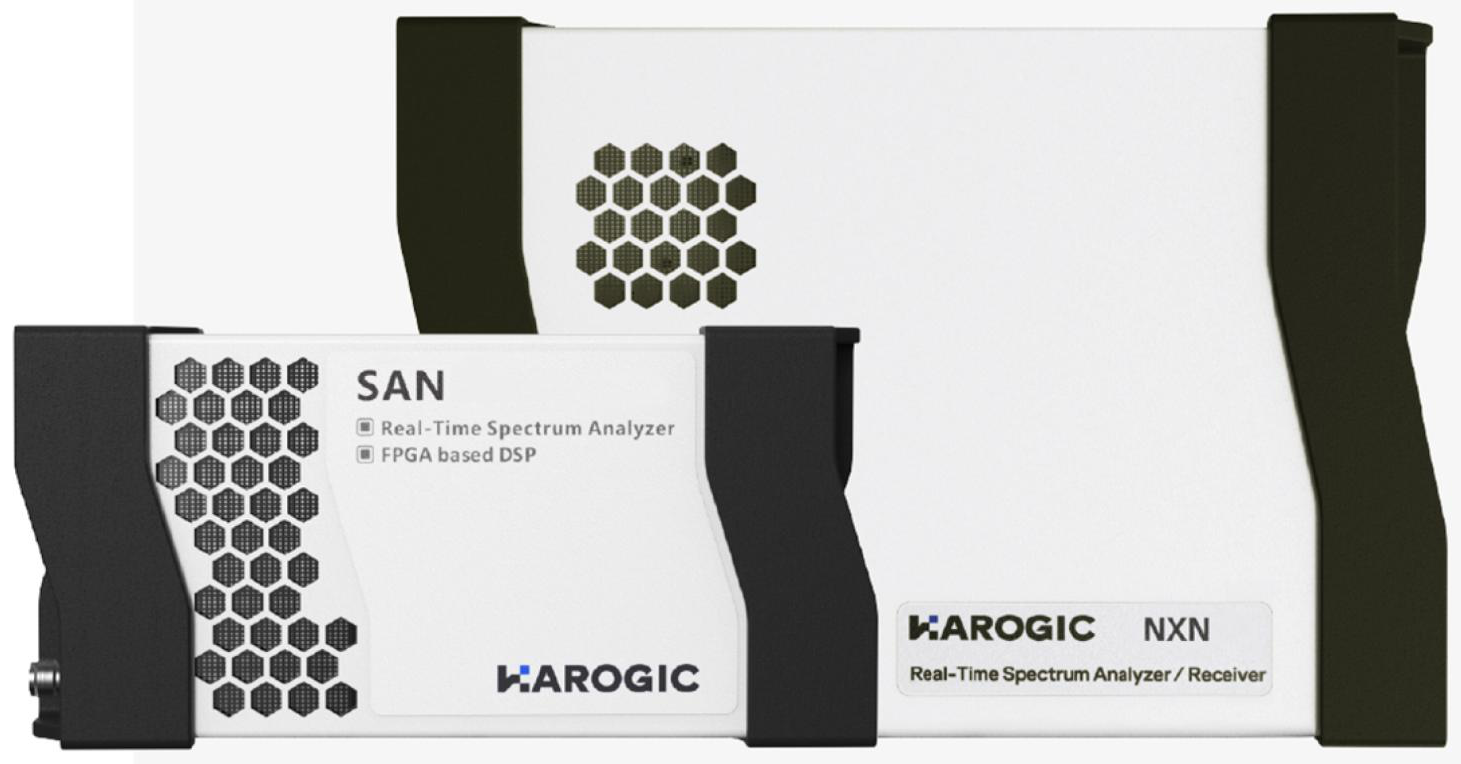
The ICX-FieldHawk-R is a high-performance real-time spectrum analyzer that delivers strong RF performance in a field-deployed package. It integrates cleanly into automated test systems, holds spectral purity under demanding conditions, and cuts both deployment and operating cost. That combination makes it well suited to space- and cost-constrained measurement where a full benchtop instrument would be impractical.
RF coverage spans 9 kHz to 9.5 or 40 GHz depending on model, with a standard 100 MHz analysis bandwidth. A high-speed FPGA FFT engine delivers gapless real-time monitoring and sweep speeds beyond 1 THz/s. The SpectraCore API supports C/C++, C#, Python, MATLAB, Qt, and LabVIEW on Windows and Linux for secondary development and integration, and the instrument speaks the standard SCPI protocol.
Key features
- Frequency range: 9 kHz to 9.5 GHz (ICX-090R) or 9 kHz to 40 GHz (ICX-400R).
- Analysis bandwidth: 100 MHz.
- 1 GHz DANL: down to -167.5 dBm/Hz (R.L. -50 dBm, 90 MHz to 3 GHz band).
- 1 GHz phase noise: better than -100 dBc/Hz at 10 kHz offset.
- Real-time FFT engine: FPGA-based, gapless and overlap-free.
- Unified API: hardware-portable, with C/C++, C#, Python, MATLAB, Qt, and LabVIEW support.
- Windows support: 11 / 10 / 8 / 7 (x86, x64, AArch64).
- Linux support: Debian 12 / 11 / 10 and Ubuntu 24.04 / 22.04 / 20.04 / 18.04 (x64, AArch64).
- Standard SCPI protocol support.
2Model Selection
Two models share the same SpectraCore software and RF architecture. They differ only in frequency ceiling. Pick the band that covers your highest signal of interest.
| Model | Frequency range | Analysis bandwidth |
|---|---|---|
| ICX-090R | 9 kHz to 9.5 GHz | 100 MHz |
| ICX-400R | 9 kHz to 40 GHz | 100 MHz |
3Operating Modes
SpectraCore, Berkeley Nucleonics' spectrum analysis firmware, offers seven main operating modes: Standard Spectrum Analysis, IQ Streaming, Power Detection Analysis, Real-Time Spectrum Analysis, Phase Noise Measurement, Digital Demodulation (option), and Harmonics Analysis. Each mode reuses the same acquisition hardware, so switching between them takes no rewiring.
Standard Spectrum Analysis
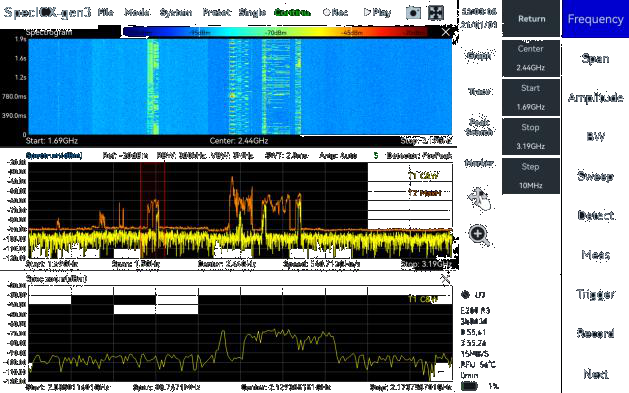
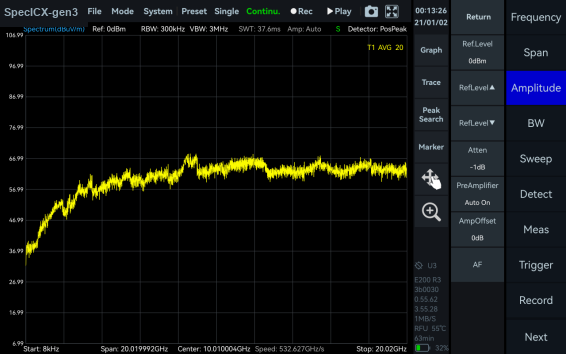
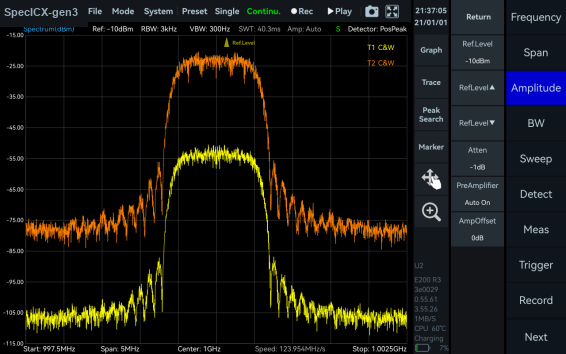
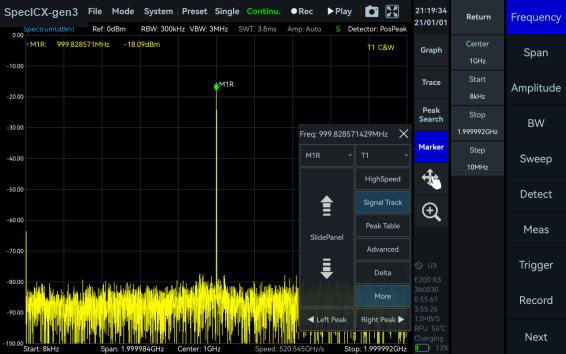
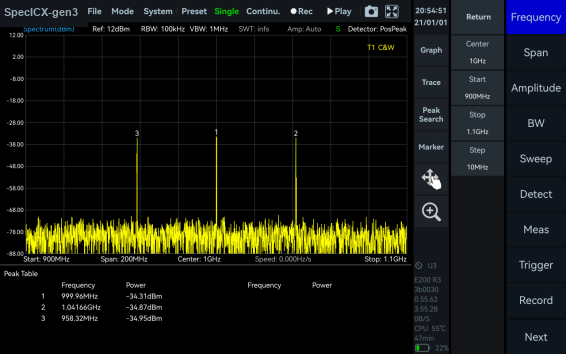
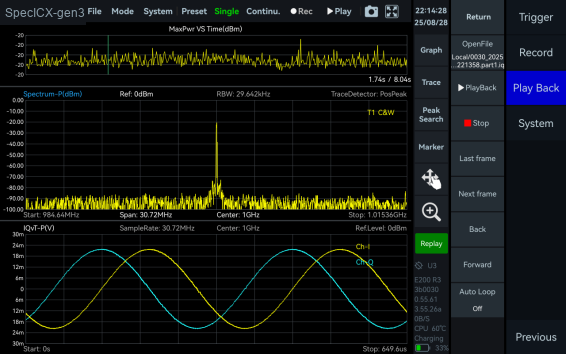
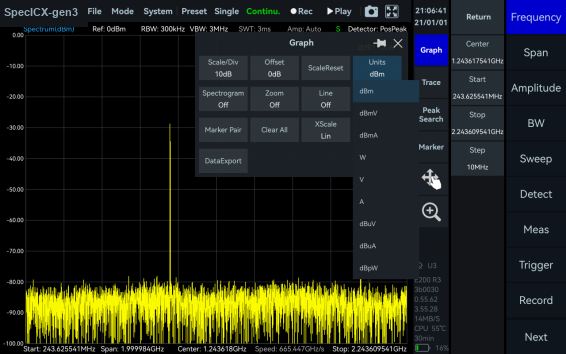
This mode provides a wide range of measurement functions, including full-span spectrum sweep, channel power, OBW, ACPR, IM3, and SEM. It also supports spectrum recording and playback. Combined with auxiliary tools such as signal tracking, the peak table, and amplitude correction, it gives you a one-stop platform for thorough spectrum inspection.
IQ Streaming
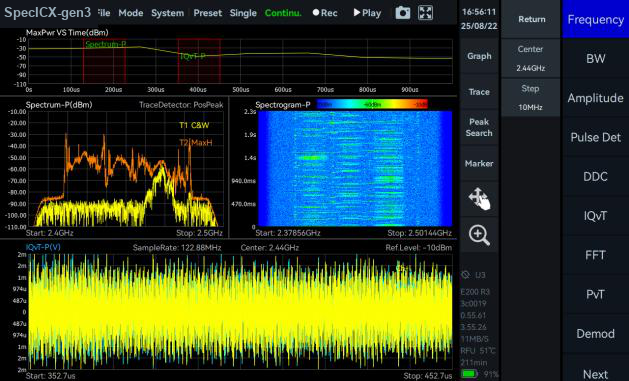
This mode supports up to 100 MHz of analysis bandwidth and acquires IQ data through multiple trigger methods. It provides IQ time-domain waveform display, spectrum and spectrogram views, AM and FM demodulation, and digital down conversion (DDC).
Power Detection Analysis
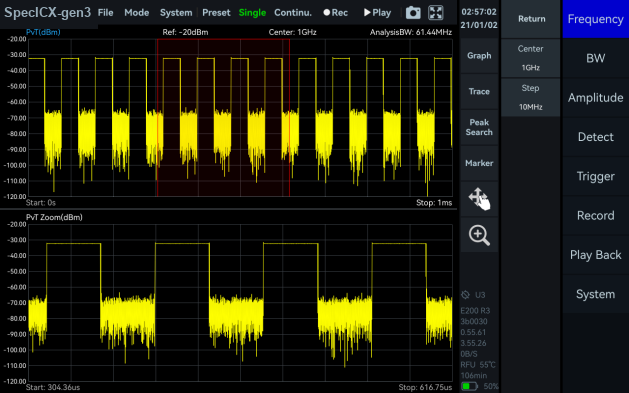
This mode detects and analyzes time-domain signals within the analysis bandwidth. It suits applications focused on in-band power versus time, such as pulse signal measurement.
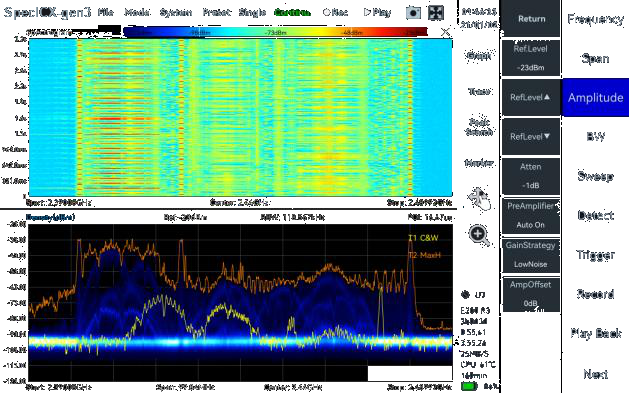
Real-Time Spectrum Analysis
This mode is powered by a high-speed, FPGA-based FFT engine. The FFT is strictly gapless and overlap-free, so the instrument achieves true real-time monitoring across the full bandwidth with no samples lost between frames.
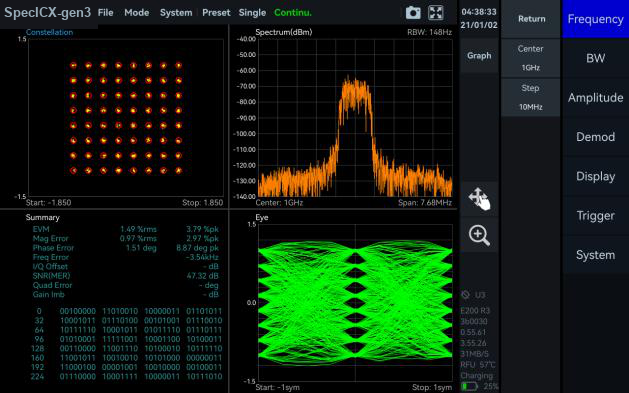
Digital Demodulation (option)
This optional mode supports 2ASK, 2FSK, 4FSK, GMSK, BPSK, QPSK, 8PSK, 16QAM, 64QAM, 128QAM, and 256QAM signals.
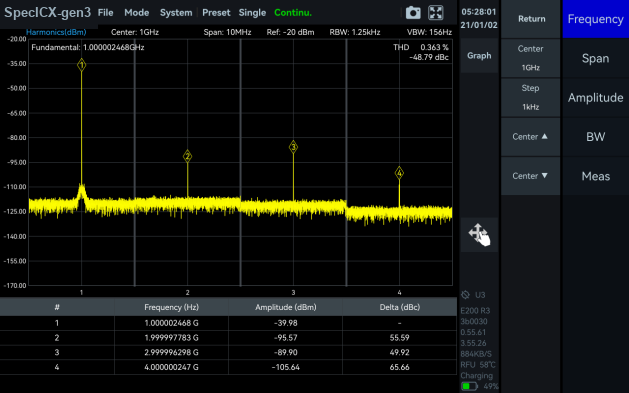
Harmonics Analysis
This mode detects and measures up to 10 harmonic components, reporting harmonic peaks, harmonic channel power, and total harmonic distortion.
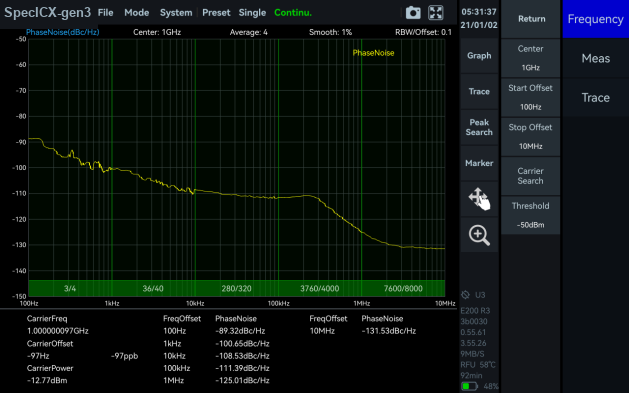
Phase Noise Measurement
This mode covers offset ranges from 1 Hz to 10 MHz for evaluating carrier phase stability. A built-in automatic carrier search quickly locates the target carrier, so no manual tuning is needed.
4Measurement Functions
The following functions are available within SpectraCore. Each is illustrated with a representative measurement screenshot from the source material.
Power and channel measurements
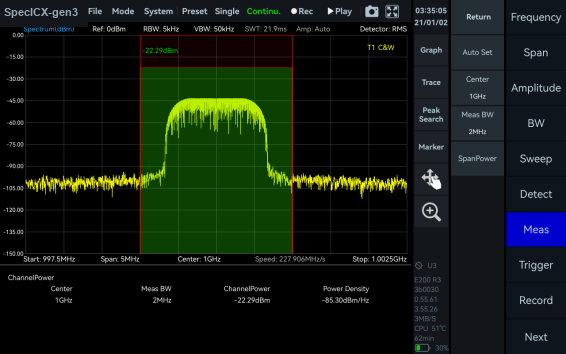
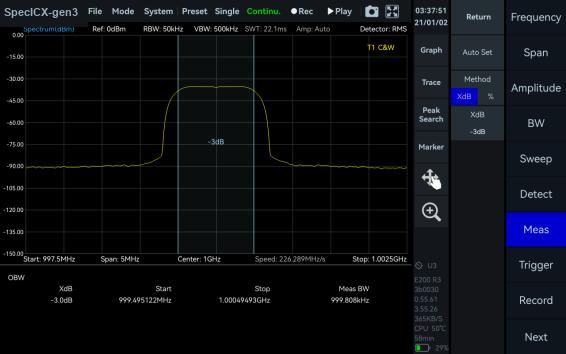
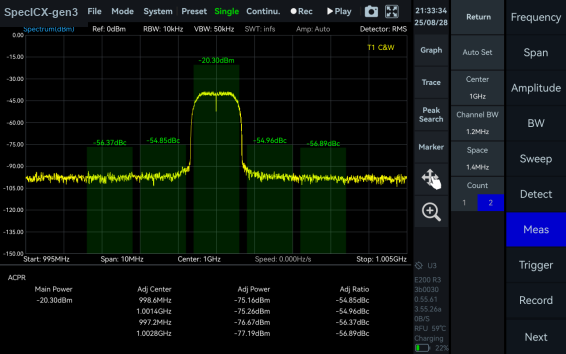
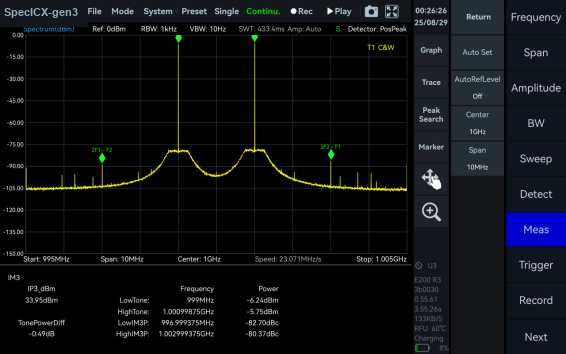
Mask and modulation analysis
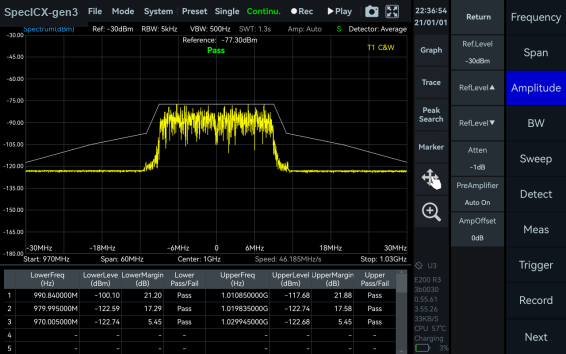
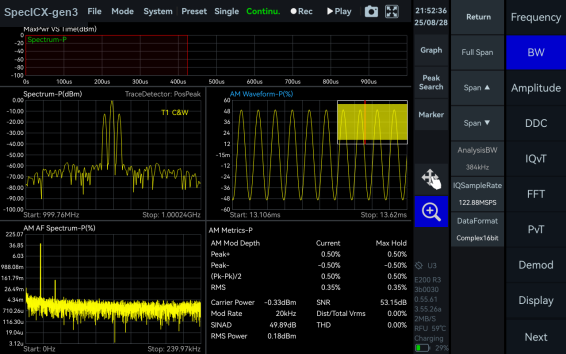
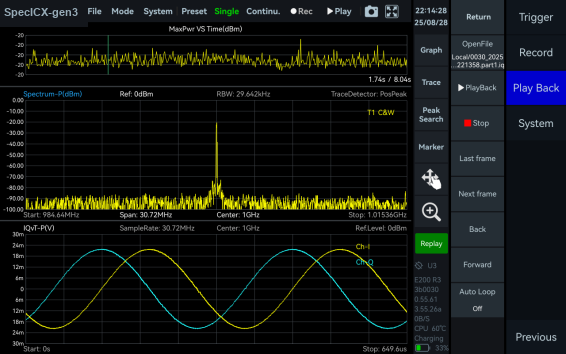
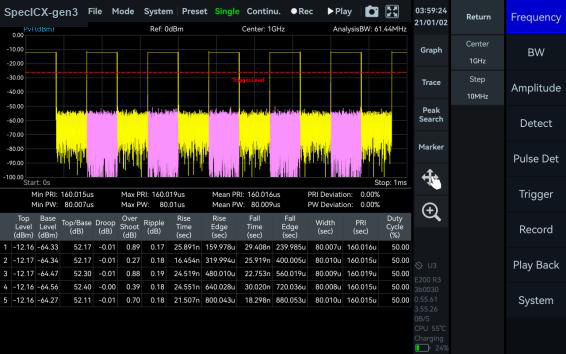
Correction and tooling
5Frequency
| Parameter | ICX-090R | ICX-400R |
|---|---|---|
| Frequency range | 9 kHz to 9.5 GHz | 9 kHz to 40 GHz |
| Reference clock | Internal or external | |
| Frequency accuracy, TCXO (std.) | <1 ppm, manual correction available | |
| Frequency accuracy, OCXO (opt 01) | <1 ppm, manual correction available | |
| Frequency accuracy, GNSS-disciplined OCXO (opt 23/06) | <0.05 ppm when locked to GNSS | |
| Aging & temp. stability, TCXO (std.) | <1 ppm/year, <1 ppm | |
| Aging & temp. stability, OCXO (opt 01) | <1 ppm/year, <0.15 ppm | |
| Aging & temp. stability, GNSS-disciplined OCXO (opt 23/06) | <1 ppm/year, <0.05 ppm | |
6Spectrum Purity
SSB phase noise (dBc/Hz)
| Offset | ICX-090R · 1 GHz | ICX-090R · 9.5 GHz | ICX-400R · 1 GHz | ICX-400R · 40 GHz |
|---|---|---|---|---|
| 1 kHz | -95.2 | -91.5 | -99.0 | -78.4 |
| 10 kHz | -101.6 | -98.5 | -107.5 | -85.7 |
| 100 kHz | -100.6 | -99.7 | -107.7 | -85.1 |
| 1 MHz | -120.9 | -116.2 | -122.7 | -100.8 |
Residual response (dBm)
Conditions: spur reject = bypass, RBW = 1 kHz, PosPeak detector.
| Frequency band | 090R · R.L. 0 dBm | 090R · R.L. -50 dBm | 400R · R.L. 0 dBm | 400R · R.L. -50 dBm |
|---|---|---|---|---|
| 9 kHz to 1 GHz | -83 | -120 | -72 | -103 |
| 1 GHz to 3 GHz | -83 | -120 | -72 | -103 |
| 3 GHz to 9.5 GHz | -90 | -130 | -72 | -103 |
| 9.5 GHz to 20 GHz | — | — | -91 | -115 |
| 20 GHz to 40 GHz | — | — | -85 | -103 |
Image rejection (dBc), typical
| Frequency band | 090R · standard | 090R · bypass | 400R · standard | 400R · bypass |
|---|---|---|---|---|
| 90 MHz to 3 GHz | >90 | >76 | >90 | — |
| 3 GHz to 9.5 GHz | >90 | >60 | >90 | — |
| 9.5 GHz to 20 GHz | — | — | >90 | — |
| 20 GHz to 33 GHz | — | — | >90 | — |
| 33 GHz to 40 GHz | — | — | >58 | — |
IF rejection and spurious (dBc), typical
| Parameter | Spur reject enhanced | Bypass |
|---|---|---|
| IF rejection | >90 | >80 |
| IF rejection (ICX-400R) | >68 (8.2 to 21.75 GHz); >90 (other bands) | — |
| Local oscillator related spurious | <-65 dBc at center frequency ± (N/M) × 125 MHz, where N, M = 1, 2, 3, 4, 5… | |
IIP3 / IIP2 (dBm)
| Reference level | 090R · 1 GHz | 090R · 9.5 GHz | 400R · 1 GHz | 400R · 40 GHz |
|---|---|---|---|---|
| R.L. = 20 dBm | 46.1 / 83.2 | 40.5 / 92.8 | 40.3 / 75.5 | 31.7 / 88.6 |
| R.L. = 0 dBm | 26.7 / 85.0 | 19.2 / 90.3 | 27.4 / 45.3 | 10.3 / 86.1 |
| R.L. = -20 dBm | 10.5 / 82.2 | 2.0 / 49.3 | 8.7 / 25.2 | 4.8 / 66.6 |
7Amplitude
| Parameter | Value | Condition |
|---|---|---|
| Max. input power (CW) | 23 dBm | 50 MHz to 9.5 / 40 GHz, preamplifier off |
| Max. input power (CW) | 10 dBm | 9 kHz to 50 MHz, or preamplifier on |
| Max. DC voltage | ±10 VDC | |
| Display range | DANL to 23 dBm | ICX-090R |
| Display range | DANL to 20 dBm | ICX-400R |
| Amplitude accuracy | ±2.0 dB | 9 kHz to 9.5 GHz |
| Amplitude accuracy | ±3.0 dB | 9.5 GHz to 40 GHz |
| IF in-band flatness | ±2.0 dB | |
| Reference level (R.L.) | -50 dBm to +23 dBm | ICX-090R |
| Reference level (R.L.) | -50 dBm to +20 dBm | ICX-400R |
| RF preamplifiers | Automatic on, or forced off | |
| VSWR | <2.0:1 | 90 MHz to max. frequency (ICX-090R) |
| VSWR | <2.0:1 / <3.0:1 | ICX-400R: 90 MHz to 16 GHz / 16 GHz to 40 GHz |
8Display Average Noise Level (DANL)
Units: dBm/Hz. Condition: RBW = 1 kHz.
| Frequency band | 090R · R.L. -20 dBm | 090R · R.L. -50 dBm | 400R · R.L. -20 dBm | 400R · R.L. -50 dBm |
|---|---|---|---|---|
| 9 kHz to 1 MHz | -143.0 | -152.4 | -136.0 | -145.8 |
| 1 MHz to 90 MHz | -152.0 | -159.2 | -153.7 | -158.0 |
| 90 MHz to 3.0 GHz | -146.0 | -167.5 | -154.1 | -159.9 |
| 3.0 GHz to 9.5 GHz | -153.6 | -167.0 | -154.1 | -159.9 |
| 9.5 GHz to 19 GHz | — | — | -156.8 | -161.5 |
| 19 GHz to 20 GHz | — | — | -145.2 | -149.3 |
| 20 GHz to 40 GHz | — | — | -145.2 | -149.3 |
9Standard Spectrum Analysis
| Parameter | Specification |
|---|---|
| Detector | PosPeak, NegPeak, Sample, Average, RMS, MaxPower |
| RBW | 0.1 Hz to 10 MHz |
| VBW | 0.1 Hz to 10 MHz |
| Data chart | SpectraCore provides spectrum, spectrogram, and historical trace views |
| Measurements | Channel power, OBW, X dB bandwidth, adjacent channel power ratio, IM3 |
Sweep speed
| Condition | ICX-090R | ICX-400R |
|---|---|---|
| RBW = 250 kHz, FPGA, spur reject = bypass | 1.1 THz/s | (verify) |
| RBW = 250 kHz, FPGA, spur reject = standard | 561.7 GHz/s | (verify) |
| RBW = 50 kHz, FPGA, spur reject = bypass | 209.8 GHz/s | (verify) |
| RBW = 1 kHz, CPU, spur reject = bypass | 4.0 GHz/s | (verify) |
10Detection Analysis
| Parameter | Specification |
|---|---|
| Lowest time resolution | 8 ns |
| Max. analysis bandwidth | 100 MHz |
| Detector | PosPeak, NegPeak, Sample, Average, RMS, MaxPower |
11IQ Recording
| Parameter | ICX-090R | ICX-400R |
|---|---|---|
| Continuous recording bandwidth | Maximum 50 MHz | (verify) |
| Burst recording bandwidth | Maximum 100 MHz. Built-in memory depth is 128 Mbytes. | |
| IQ sample rate | Maximum 125 MSPS. Decimate factor: 1, 2, 4, 8, 16, 32, 64, 128, 256, 512, 1024, 2048, 4096. | |
| External trigger response | Maximum frequency response: 500 times/s | |
12Real-Time Spectrum Analysis
The FFT engine is implemented in the FPGA. Frame compression and trace detection are supported, and there are no missing samples between FFT frames. The frame update rate and probability of intercept (POI) follow these relations:
FFT frame update rate = 10^9 ns / (N × D × 8 ns)POI = 2 × N × D × 8 ns
where N is the FFT point count (2048, 1024, 512, 256, 128, 64, 32) and D is the decimate factor (1, 2, 4, 8, ...).
| Typical setting | FFT refresh rate | POI |
|---|---|---|
| N = 2048, D = 1 | 61,035 times/sec | 32.768 µs |
| N = 32, D = 1 | 3,906,250 times/sec | 0.512 µs |
| Parameter | Specification |
|---|---|
| Max. analysis bandwidth | 100 MHz |
| Window function | B-Nuttall, Flat-top, LowSideLobe |
| RBW | 14.73 MHz to 3.59 kHz (Flat-top); 7.81 MHz to 1.90 kHz (B-Nuttall); 13 grades for each window type |
| Amplitude resolution | 0.75 dB |
13General & Physical
Input and output
| Parameter | ICX-090R (USB form) | ICX-090R (networked form) |
|---|---|---|
| RF input | SMA (F) at 9.5 GHz; 2.92 mm (F) at 20 GHz; 2.4 mm (M) at 40 GHz (verify) | SMA (F) at 9.5 GHz; 2.92 mm (F) at 20 GHz; 2.4 mm (M) at 40 GHz (verify) |
| Impedance | 50 Ω | |
| Power | Type-C, 5V 2A supply capacity. Voltage range 4.75 to 5.25 V, ripple <200 mVpp. | Type-C, 12V 2A supply capacity. Voltage range 9 to 12 V, ripple <200 mVpp. |
| Host port | Type-C, USB 3.0 (USB 2.0 bandwidth limited). Requires 5V 0.9A supply. | RJ45: 1000 Mbps × 1, 100 Mbps × 1 |
| External trigger input | Integrated in AUXIO, 3.3 V CMOS, high impedance | MMCX (F), 3.3 V CMOS, high impedance |
| Trigger output | Integrated in AUXIO, 3.3 V CMOS | MMCX (F), 3.3 V CMOS |
| Analog IF output | MMCX (F), maximum output power -25 dBm, impedance 50 Ω, 307.2 MHz ± 50 MHz | |
| External reference clock input | MMCX (F), amplitude ≥ 1.5 Vpp, impedance 330 Ω | |
| Reference clock output | Integrated in AUXIO, 3.3 V CMOS, programmable on/off | |
Physical and environmental
| Parameter | 9.5 GHz (USB / networked) | 40 GHz (USB / networked) |
|---|---|---|
| Weight | 383 g (USB) / 680 g (networked) | (verify) |
| Size (D × W × H) | 131 × 70 × 30 mm (USB); 167 × 117 × 30 mm (networked) | (verify) |
| Power consumption | 10 to 14 W (USB form); 13 to 16 W (networked form) | |
| GNSS type | External (USB form); Internal (networked form) | |
| GNSS 1PPS sync accuracy | USB form: Opt21 ±100 ns, Opt22 ±75 ns, opt23 ±50 ns. Networked form: Std ±100 ns, Opt05 ±75 ns, Opt06 ±50 ns. | |
| Packaging and accessories | Flash disk × 1, USB 3.0 cable × 2, power adapter × 1 | (verify) |
| System requirements | Windows 11/10/8/7 (x86, x64, AArch64; AArch64 on the networked line only). Debian 12/11/10 (x64, AArch64). Ubuntu 24.04/22.04/20.04/18.04 (x64, AArch64). | |
| Operating / storage temperature (ambient), T0 class (std.) | 0 to 50 °C / -20 to +70 °C | |
| Operating / storage temperature, T1 class (opt40) | -20 to +65 °C / -40 to +85 °C | |
| Operating / storage temperature, T2 class (opt41) | -40 to +65 °C / -40 to +85 °C | |
| Operating relative humidity | 5 to 75% at ambient 0 to 40 °C; 5 to 45% at ambient above 40 °C | |
14Test Conditions
Specifications apply under the following conditions:
- Startup. Start up and warm up for 10 minutes.
- Temperature. Ambient temperature 25 °C (core temperature 50 °C).
- Mode. Standard spectrum analysis mode, spurious rejection set to standard.
- Cooling. Adequate heat dissipation is provided so that ambient and core temperatures stay within the rated range simultaneously.
- Firmware. Sweep speed and DANL tested with MCU 0.55.57, FPGA 0.55.22, API 0.55.61.
15Options
The following option codes are reproduced from the source documentation. Each is a built-in hardware option, an accessory, or a software license. The option-numbering scheme and antenna part numbers are inherited from the source and should be reconciled to the Berkeley Nucleonics catalog before quoting. verify.
| Code | Description | Type |
|---|---|---|
| Built-in hardware | ||
| 01 | Built-in OCXO reference clock | Built-in hardware |
| 05 | Internal high precision GNSS | Built-in hardware |
| 06 | Built-in GNSS disciplined reference clock | Built-in hardware |
| 40 | T1 temperature class | Built-in hardware |
| 41 | T2 temperature class, only available for core | Built-in hardware |
| Accessories | ||
| 20 | AUXIO I/O expansion board | Accessory |
| 21 | External GNSS | Accessory |
| 22 | External high precision GNSS | Accessory |
| 23 | External GNSS disciplined OCXO reference clock | Accessory |
| 34 | External omnidirectional antenna, 400 MHz to 8000 MHz, gain <2 dBi | Accessory |
| 35 | External active directional antenna, 0.5 to 10 GHz, gain <5 dBi (amp off), <25 dBi (amp on) | Accessory |
| Software | ||
| 71 | Basic digital demodulation | Software |
| 72 | Pulse detection | Software |
16Model & Software Reference
Model mapping
| BNC ICX model | Product line | Frequency range |
|---|---|---|
| ICX-090R | ICX-FieldHawk-R (Field Ready) | 9 kHz to 9.5 GHz |
| ICX-400R | ICX-FieldHawk-R (Field Ready) | 9 kHz to 40 GHz |
The numeric part of each model number is the maximum frequency in GHz multiplied by 10. The R suffix denotes the FieldHawk-R Field-Ready line. The line covers two frequency variants (9.5 and 40 GHz). The 40 GHz ICX-400R, including its 2.4 mm (M) RF input, is specified from the 40 GHz product documentation; IP68 enclosure attributes remain to be confirmed. verify.
Software
All measurement modes and functions described in this manual run in SpectraCore, Berkeley Nucleonics' spectrum analysis firmware. SpectraCore runs on Windows and Linux and pairs with the unified API for automated control. The figures in sections 3 and 4 are SpectraCore screenshots.
Packaging
Each unit ships with a flash disk, the appropriate USB cable set, and a power adapter, as listed under General & Physical. IP68 case packaging contents for the FieldHawk-R should be confirmed against the FieldHawk-R datasheet. verify.
Contact and ordering
To request a quote, arrange a demonstration, or confirm configuration and options for your application, reach the Berkeley Nucleonics team at info@berkeleynucleonics.com or 800-234-7858. Berkeley Nucleonics Corporation, 2955 Kerner Blvd, San Rafael, CA 94901.